
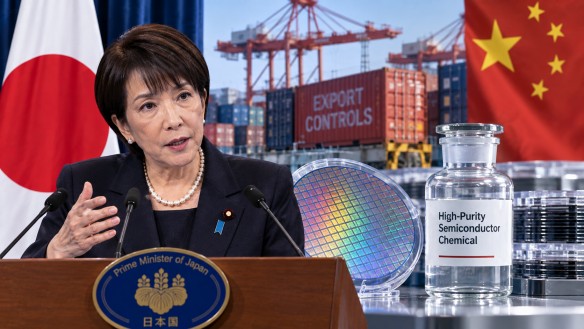
Japan has expressed its disapproval of China’s recent move to impose stringent export restrictions on dichlorosilane (DCS), a chemical essential in the semiconductor manufacturing industry. These new measures, which require Chinese importers to pay cash deposits of up to 99.2% on DCS imports from Japan, have prompted Japan to evaluate the potential repercussions on its domestic companies, including major exporters Shin-Etsu Chemical and Denal Silane.
According to Chinese authorities, these restrictions are temporary and stem from an anti-dumping investigation that concluded Japanese DCS exports negatively impacted China’s local industry. A definitive verdict on the matter will be made following the investigation’s completion. In response, the Japanese government has called on China to ensure that these measures do not unjustly hinder Japanese businesses and has indicated its readiness to take necessary actions if required.
The imposition of these restrictions occurs against a backdrop of deteriorating relations between China and Japan, particularly concerning Japan’s stance on Taiwan. This development is part of a broader pattern of trade and export limitations China has introduced, affecting Japanese firms and products that could be used for both civilian and military purposes.
Dichlorosilane plays a crucial role in the semiconductor production process, as it is used to deposit ultra-thin silicon layers and other materials on computer chips. Given Japan’s significant contribution to the global supply of high-purity DCS, China’s new export rules could have substantial implications for the semiconductor supply chain worldwide.